10 things from Huberman's peptide episode, checked against the record
Disclosure: Dr. Peppa is owned and operated by Medtruva LLC, which sells peptide products, including some compounds discussed on this site. Advertisements are labeled.
The quick version
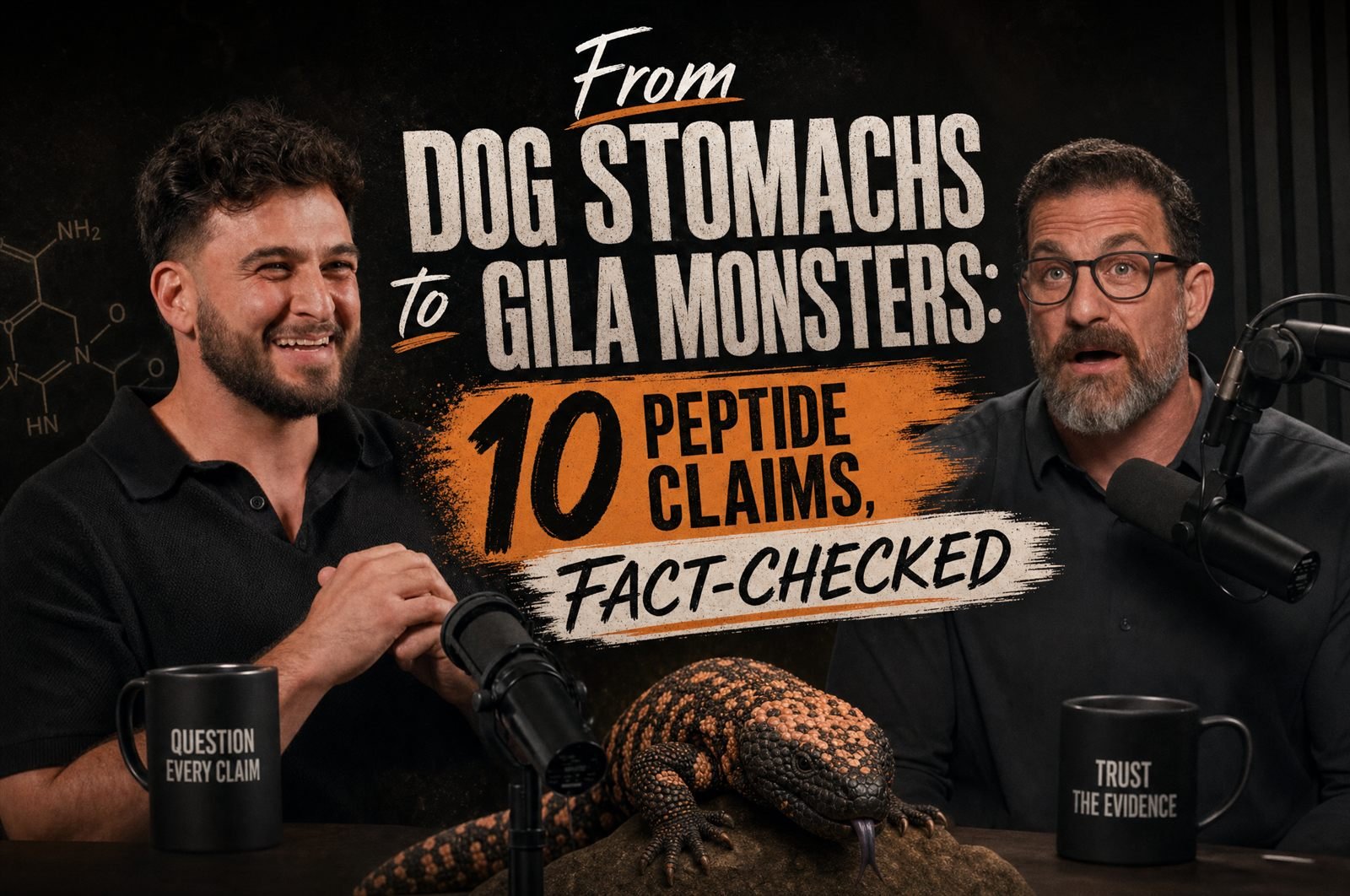
- On June 1, 2026, Huberman Lab published a 2 hour 48 minute episode on peptides with Dr. Abud Bakri. It has passed 770,000 views on YouTube.
- We picked the 10 most surprising, checkable claims and verified each against primary sources.
- 5 hold up, 4 are partly right, and 1 is wrong. The biggest miss: thymosin alpha-1 is not FDA-approved.
- Several stories that circulate widely, including an Olympian's miracle recovery, couldn't be traced to any credible source.
The episode
Peptides: The Science, Uses & Safety is a long-form interview between Andrew Huberman, a Stanford neurobiologist, and Abud Bakri, MD, a board-certified internal medicine physician. It covers the history of several peptides, the state of the evidence, compounding law, and the gray market.
Disclosures worth knowing. Bakri's website lists him as medical director at a company called The Systems, a member of the Enhanced Games' independent medical commission, and a co-founder of a nonprofit telehealth group. It also offers paid patient care and lab-testing services. He didn't state a formal conflict-of-interest disclosure on the episode. Huberman said during the episode that he has used peptides obtained through compounding pharmacies. The episode carried four sponsor segments.
The conversation includes personal-use stories and dosing discussion. We don't repeat either. This piece covers the history, law and evidence.
1. BPC-157 traces back to Pavlov's stomach-juice business
What was said: Bakri told a chain of history. Ivan Pavlov collected gastric juice from dogs and sold it as a remedy for indigestion. Hans Selye's stress research later showed that stress damages the stomach lining. A research group in Croatia then went looking for the protective compound in gastric juice, found a large protein they called "body protection compound," and isolated a 15-amino-acid fragment from it: BPC-157.
What the record shows: Each link checks out.
- Pavlov's biographer Daniel Todes has written that Pavlov more than doubled his lab budget by bottling and selling dog gastric juice as a remedy for dyspepsia.
- Selye's 1936 paper in Nature described the "stress triad": enlarged adrenal glands, a shrunken thymus, and stomach erosions.
- The earliest BPC paper we found on PubMed is from 1992, by Predrag Sikiric's group in Zagreb. A 1993 overview describes the parent protein and its 15-amino-acid fragment, BPC-157.
Verdict: Holds up. The Croatian work began in the early 1990s; the first indexed paper is from 1992.
2. Nearly all the BPC-157 research comes from one lab
What was said: Bakri said almost all the animal research on BPC-157 comes from one group in Croatia, that no receptor for it has been identified, and that the human evidence amounts to small early trials published only as abstracts.
What the record shows:
- One lab. STAT reported in February 2026 that the vast majority of roughly 200 BPC-157 studies on PubMed include Sikiric or a close colleague as a main author. Our own PubMed search found Sikiric listed on 175 of 227 records.
- No receptor. FDA's July 2026 briefing document says "the molecular targets for BPC-157 have not been identified and its mechanisms of action remain poorly understood."
- Human data. FDA's appendix lists five human reports. Two are drug-company enema studies from the early 2000s published only as meeting abstracts. The other three are a retrospective chart review, a 12-person study, and a 2-person safety pilot. A registered phase 1 trial started in 2015, and its results submission was cancelled in 2016.
Bakri also said patent ownership helps explain why no one funds a large trial. The original patents are held by the individual Croatian inventors and have expired. A newer patent on a salt form is held by a small Croatian company. We found none assigned to the drugmaker Pliva, as was suggested on the episode.
Verdict: Holds up. One detail is off: the patents aren't held by Pliva.
3. The compounding ban, and the "PDA" workaround
What was said: Bakri said FDA placed BPC-157 on its "do not compound" list, that compounding pharmacies responded by selling "pentadecapeptide arginate" (PDA), which he described as the same molecule in a different salt form, and that BPC-157 came off the restricted list in April 2026 without being approved for compounding.
What the record shows:
- FDA placed BPC-157 in its restricted category (Category 2) in September 2023, not late 2024.
- As of April 22, 2026, FDA's safety-risk page lists BPC-157 under "nominated but withdrawn." FDA's Category 1 list, updated May 14, 2026, doesn't include it.
- A later development: in July 2026, FDA's advisory committee voted to recommend adding BPC-157 to the list pharmacies may compound from. That recommendation is non-binding and still needs formal rulemaking.
- On PDA: a Croatian patent does claim arginine salts of BPC-157. FDA's briefing notes it has encountered "multiple salts, and derivatives… sold commercially under the same common name." FDA doesn't mention PDA by name, and the claim that PDA is sold as a BPC-157 alternative comes from the pharmacies' own marketing.
Verdict: Partly true. The April 2026 status is right. The ban's date was wrong, and the PDA claim is plausible but not confirmed by any regulator.
4. Banned in sport, and a recovery story nobody can source
What was said: Bakri said BPC-157 is now banned by the World Anti-Doping Agency and can be detected in testing. Huberman raised a story that an athlete fully ruptured an Achilles tendon, used BPC-157, and still won an Olympic medal. Bakri called it hearsay that sellers used as marketing.
What the record shows:
- USADA confirms BPC-157 was added to the 2022 Prohibited List under the "non-approved substances" category.
- Detection methods have been published, including a 2023 study identifying BPC-157's breakdown products for doping control.
- The recovery story circulates online attached to a real Olympian's publicly reported injury. The claim that the athlete used BPC-157 appears only in blogs and newsletters. We found no statement from the athlete and no credible reporting, so we aren't repeating the name.
Verdict: Holds up. Bakri was right to call the Olympic story unverified. It still is.
5. The gray market and where peptides are made
What was said: Bakri estimated that Americans spent $5 to $10 billion on gray-market peptides in 2025, said the raw ingredients for essentially all peptides are made in China, and said gray-market vials often don't contain what the label says. Huberman noted that a major research-peptide website had shut down.
What the record shows:
- Market size. We found no published estimate that supports $5 to $10 billion. The only data point we found is much narrower: a blockchain analytics firm estimated crypto payments to gray-market peptide sellers were running above $100 million a year in 2026. That covers only crypto, so it can't settle the question either way.
- China. China is a major source, but not the only one. In 2025 testimony to Congress, a patient-safety group reported that of 239 shipments of semaglutide or tirzepatide ingredients from unregistered makers, 60 came from China or Hong Kong, 42 from India and 49 from Canada.
- Wrong contents. Australia's drug regulator tested a vial sold as retatrutide after a patient was seriously injured. It contained no retatrutide, only undeclared semaglutide. We couldn't document the specific mix-up described on the episode.
- The shutdown. Legal and industry sites report the website announced it was closing in March 2026. We didn't find coverage in major news outlets.
Verdict: Partly true. Substituted and mislabeled products are documented. "All from China" overstates it, and the $5 to $10 billion figure is a guess.
6. Retatrutide sits right at the line between drug and biologic
What was said: Bakri said retatrutide is 39 amino acids long, just under the 40-amino-acid threshold where FDA treats a molecule as a biologic. He said Eli Lilly wants biologic status, which brings longer market exclusivity and blocks compounding, as happened to hCG. Huberman estimated biologics get about 15 years of exclusivity versus 5 to 7 for other drugs.
What the record shows:
- The line. FDA regulation 21 CFR 600.3(h)(6) defines a protein as "any alpha amino acid polymer with a specific, defined sequence that is greater than 40 amino acids in size."
- hCG. Chorionic gonadotropin was among the products moved to biologic status on March 23, 2020, which ended its compounding under the usual pharmacy rules.
- Lilly. Lilly's Q2 2026 results say it plans to submit a Biologics License Application for retatrutide in early 2027. The length is also in court. A federal judge in Indiana sided with FDA in 2025 that retatrutide isn't a "protein," describing it as a 39-amino-acid chain plus a two-amino-acid attachment. Lilly counts 41 and has appealed.
- Exclusivity. Huberman's numbers were off. Federal law gives biologics 12 years and new chemical entities 5 years. Seven years is orphan-drug exclusivity, which is a separate program.
Verdict: Partly true. The core point is right, and more contested than it sounded. The exclusivity figures were wrong.
7. Doctors irradiated infants' thymus glands for decades
What was said: Bakri described how doctors once irradiated children's thymus glands, believing an enlarged thymus caused sudden infant death. He said at least 10,000 people later died of cancer, and attributed the underlying idea to the pathologist Rudolf Virchow.
What the record shows:
- The practice was real. It was first reported in 1907. One history says it largely stopped in the 1940s, but a major follow-up study includes infants treated as late as 1957.
- The harm was real. In that Rochester cohort, irradiated children later had 50 thyroid cancers compared with 13 among their siblings.
- The 10,000 figure traces back to a 1991 essay by neuroscientist Robert Sapolsky. We found no epidemiological study behind the number.
- Virchow didn't coin it. The term "status thymicolymphaticus" was introduced by Arnold Paltauf in 1889. Virchow's earlier work shaped the idea, and he endorsed the treatment, but the attribution as stated is wrong.
Verdict: Partly true. The history and the cancers are well documented. The death toll is unverified, and the attribution is off.
8. Removing the thymus in adults is linked to worse outcomes
What was said: Bakri said surgeons often remove leftover thymus tissue during heart surgery, that a New England Journal of Medicine study linked this to higher death and cancer rates, and that a 2026 study in Nature tied a better thymus "health score" to lower mortality.
What the record shows: Both studies exist and say roughly what he described.
- The 2023 NEJM study compared adults who had their thymus removed with matched surgical patients. At five years, deaths from any cause were 8.1% versus 2.8%, and cancer was 7.4% versus 3.7%. Autoimmune disease showed no overall difference, though a difference appeared after excluding people with pre-existing conditions.
- The 2026 Nature study used a deep-learning score of thymus health from CT scans in more than 27,000 people. A higher score was associated with lower all-cause mortality.
- Both are observational, so they show association, not cause.
Verdict: Holds up.
9. Thymosin alpha-1 is not FDA-approved
What was said: Bakri described thymosin alpha-1 as a 21-amino-acid peptide discovered in Allan Goldstein's lab, and said it was FDA-approved under the brand name Zadaxin for children born without a working thymus, though he wasn't sure the approval still stood.
What the record shows:
- The origin is right. Goldstein's lab described thymosin alpha-1 in a 1977 paper as one of several peptides in an extract called thymosin fraction 5.
- The length is wrong. That same paper describes it as "composed of 28 amino acid residues."
- It isn't FDA-approved. FDA's own December 2024 advisory committee slides state that thymosin alpha-1 "is not approved in the United States, Japan, or Europe (except Italy)." Drugs@FDA has no listing for it. It is approved in a number of other countries, according to its manufacturer, which FDA notes it can't independently verify.
Verdict: Wrong. This was the clearest factual error in the episode.
10. GLP-1 drugs began with Gila monster venom
What was said: Bakri said today's GLP-1 drugs trace back to a compound found in Gila monster venom, that the first drug based on it came out about 25 years ago, and that newer drugs produce far more weight loss than older ones.
What the record shows:
- The venom. Endocrinologist John Eng reported exendin-4 from Gila monster venom in 1992.
- The first drug. Exenatide (Byetta), based on that discovery, was approved in April 2005, about 21 years ago rather than 25.
- Weight loss. Average results at the main trial endpoints:
| Trial | Drug | Mean weight change | Placebo |
|---|---|---|---|
| STEP-1, 68 weeks | Semaglutide | −14.9% | −2.4% |
| SURMOUNT-1, 72 weeks | Tirzepatide | up to −20.9% | −3.1% |
| Retatrutide phase 2, 24 weeks | Retatrutide | up to −17.5% | −1.6% |
Retatrutide is not approved anywhere. The episode also touched on reports of unplanned pregnancies on these drugs. The tirzepatide label does warn it may reduce the effectiveness of oral contraceptives. We found no controlled study measuring whether unplanned pregnancies actually increased.
Verdict: Holds up. The Byetta timeline was a few years off.
What we couldn't verify
- That any Olympic athlete used BPC-157 to recover from an Achilles rupture
- $5 to $10 billion in annual US gray-market peptide spending
- The estimate of more than 10,000 cancer deaths from infant thymus irradiation
- That PDA sold by compounding pharmacies is chemically identical to BPC-157 in a different salt form, as confirmed by any regulator
The bottom line
For a nearly three-hour conversation, the episode's history and science held up well. Bakri was also careful about the limits of the evidence, repeatedly separating animal results from human ones and calling out unsourced stories.
The errors were in specifics: a peptide's length, an approval that doesn't exist, the wrong pathologist, and exclusivity numbers. None changes the big picture, but the thymosin alpha-1 claim matters, because "FDA-approved" is the kind of phrase that gets repeated.
The fact-check scorecard
Ten claims, each checked against primary documents. Details and sources for every verdict are in the sections above.
1. BPC-157 traces back to Pavlov and Selye
Holds upPavlov sold dog gastric juice; Selye's 1936 paper; Croatian BPC work from 1992.
2. Nearly all research comes from one lab
Holds upSikiric is on 175 of 227 PubMed records. No receptor identified. Human data is thin.
3. The compounding ban and "PDA"
Partly trueApril 2026 status is right. The ban dates to 2023, not 2024. PDA isn't confirmed by regulators.
4. Banned in sport; the Olympic story is hearsay
Holds upOn WADA's list since 2022. The recovery story still has no credible source.
5. The gray market and China
Partly trueMislabeled vials are documented. China is a major source, not the only one. The market size is a guess.
6. Retatrutide and the biologic line
Partly trueThe 40-amino-acid rule and Lilly's plans are real. The length is disputed in court. Exclusivity numbers were wrong.
7. Infant thymus irradiation
Partly trueThe practice and later cancers are documented. The death toll is unverified. Paltauf, not Virchow, coined the term.
8. Thymus removal in adults
Holds upNEJM 2023 and Nature 2026 studies exist and match the description. Both are observational.
9. Thymosin alpha-1 is FDA-approved
WrongFDA says it isn't approved in the US. It's also 28 amino acids, not 21.
10. GLP-1s began with Gila monster venom
Holds upExendin-4 was reported in 1992; Byetta was approved in 2005.
Sources
The episode
- Huberman Lab, Peptides: The Science, Uses & Safety | Dr. Abud Bakri, 1 June 2026 — https://www.youtube.com/watch?v=_DfqnpSbMfE
- Huberman Lab episode page and transcript — https://www.hubermanlab.com/episode/peptides-the-science-uses-and-safety-abud-bakri
- Abud Bakri, MD, biography — https://abudbakri.com/bio.html
Law and FDA records
- FDA, Briefing document: BPC-157, Pharmacy Compounding Advisory Committee, July 2026 — https://www.fda.gov/media/193343/download
- FDA, Certain bulk drug substances for use in compounding that may present significant safety risks — https://www.fda.gov/drugs/human-drug-compounding/certain-bulk-drug-substances-use-compounding-may-present-significant-safety-risks
- FDA, 503A Category 1 bulk drug substances list (updated 14 May 2026) — https://www.fda.gov/media/94155/download
- FDA, Final rule, Definition of the term "biological product" (85 FR 10057, 21 February 2020) — https://www.govinfo.gov/content/pkg/FR-2020-02-21/html/2020-03505.htm
- FDA, Guidance on the "deemed to be a license" transition — https://www.fda.gov/media/135838/download
- 42 U.S.C. § 262, Regulation of biological products — https://www.law.cornell.edu/uscode/text/42/262
- FDA, Frequently asked questions on patents and exclusivity — https://www.fda.gov/drugs/development-approval-process-drugs/frequently-asked-questions-patents-and-exclusivity
- FDA, Pharmacy Compounding Advisory Committee slides on thymosin alpha-1, 4 December 2024 — https://www.fda.gov/media/183892/download
- FDA, Byetta approval package (2005) — https://www.accessdata.fda.gov/drugsatfda_docs/nda/2005/021773_Byetta_approv.PDF
- FDA, Zepbound prescribing information (2025) — https://www.accessdata.fda.gov/drugsatfda_docs/label/2025/217806Orig1s020lbl.pdf
- US Patent 6,288,028 (BPC peptides) — https://patents.google.com/patent/US6288028B1/en
- US Patent 9,850,282 (BPC-157 salts) — https://patents.google.com/patent/US9850282B2/en
- USADA, Key changes to the 2022 Prohibited List — https://www.usada.org/athlete-advisory/key-changes-2022-prohibited-list/
- Eli Lilly, Q2 2026 results (SEC filing) — https://www.sec.gov/Archives/edgar/data/0000059478/000005947826000077/q226lillysalesandearningsp.htm
- Testimony of Shabbir Safdar, House Oversight Committee, 9 April 2025 — https://www.congress.gov/119/meeting/house/118131/witnesses/HHRG-119-GO00-Wstate-SafdarS-20250409-SD001.pdf
Studies
- Selye, A syndrome produced by diverse nocuous agents, Nature (1936) — https://www.nature.com/articles/138032a0
- Sikiric et al., The significance of the gastroprotective effect of body protection compound (1992) — https://pubmed.ncbi.nlm.nih.gov/1345210/
- Sikiric et al., overview of BPC and BPC 157 (1993) — https://pubmed.ncbi.nlm.nih.gov/8298609/
- Józwiak et al., BPC-157 review, Pharmaceuticals (2025) — https://pmc.ncbi.nlm.nih.gov/articles/PMC11859134/
- Tian et al., Identification of BPC-157 metabolites for doping control, Molecules (2023) — https://pmc.ncbi.nlm.nih.gov/articles/PMC10650108/
- Ritterman, history of thymic irradiation, The Permanente Journal (2017) — https://pmc.ncbi.nlm.nih.gov/articles/PMC5478585/
- A fresh look at the history of SIDS — https://pmc.ncbi.nlm.nih.gov/articles/PMC6474527/
- Adams et al., Rochester thymus irradiation cohort, Radiation Research (2010) — https://pubmed.ncbi.nlm.nih.gov/21128799/
- Kooshesh et al., Health consequences of thymus removal in adults, NEJM (2023) — https://pubmed.ncbi.nlm.nih.gov/37530823/
- Bernatz et al., Thymic health consequences in adults, Nature (2026) — https://www.nature.com/articles/s41586-026-10242-y
- Goldstein et al., Thymosin alpha 1, PNAS (1977) — https://www.pnas.org/doi/10.1073/pnas.74.2.725
- Eng et al., Exendin-4 from Gila monster venom, J Biol Chem (1992) — https://pubmed.ncbi.nlm.nih.gov/1313797/
- Wilding et al., STEP-1, NEJM (2021) — https://pubmed.ncbi.nlm.nih.gov/33567185/
- Jastreboff et al., SURMOUNT-1, NEJM (2022) — https://pubmed.ncbi.nlm.nih.gov/35658024/
- Jastreboff et al., Retatrutide phase 2, NEJM (2023) — https://pubmed.ncbi.nlm.nih.gov/37366315/
Reporting and other
- Oxford University Press blog, Ivan Pavlov's surprising facts (2014) — https://blog.oup.com/2014/11/ivan-pavlov-surprising-facts/
- STAT, BPC-157 science, safety and regulatory questions (3 February 2026) — https://www.statnews.com/2026/02/03/bpc-157-peptide-science-safety-regulatory-questions/
- Chainalysis, Gray-market peptide crypto payments (2026) — https://www.chainalysis.com/blog/gray-market-peptide-crypto-boom/
- ABC News (Australia), TGA peptide warning after counterfeit retatrutide (14 September 2026) — https://www.abc.net.au/news/2026-09-14/tga-peptide-warning-retatrutide-torn-oesophagus/107143510