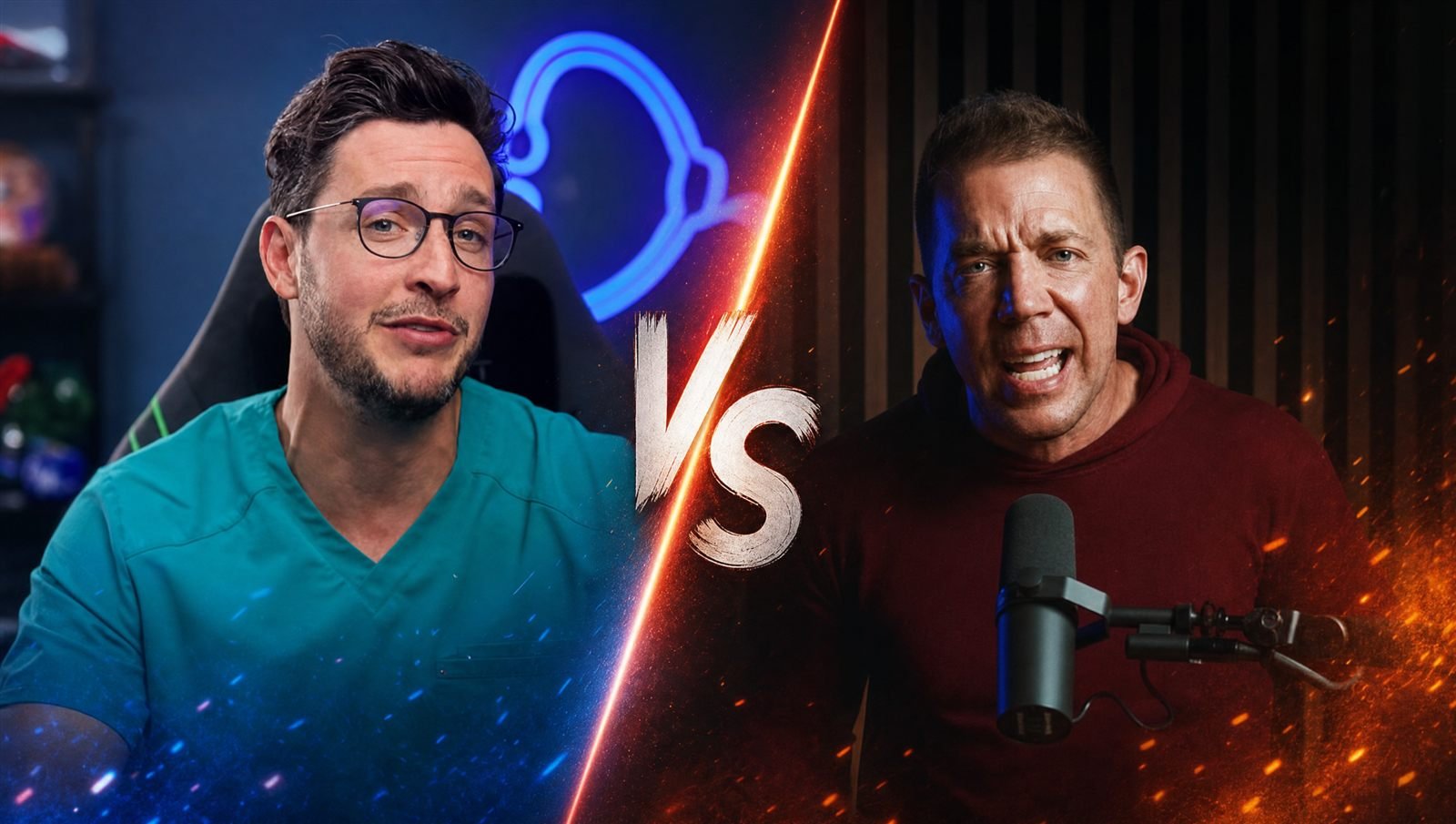
Doctor Mike vs. Dr. Alex Tatem on the FDA peptide vote: we checked the documents
Disclosure: Dr. Peppa is owned and operated by Medtruva LLC, which sells peptide products, including some compounds discussed on this site. Advertisements are labeled.
The quick version
- In July, an FDA advisory committee voted to recommend six of seven peptides for a list that lets pharmacies compound them. FDA's own reviewers had recommended against all seven.
- Doctor Mike argued the vote was driven by newly appointed members with industry ties. The FDA roster and the reported vote counts back his core point.
- Dr. Alex Tatem argued Doctor Mike misdescribed the law. The regulation text backs Tatem on that. Several of Tatem's own supporting details don't hold up.
- Neither the vote nor the list is FDA approval. Both doctors say so.
The two videos
On September 9, Mikhail Varshavski, DO, who posts as Doctor Mike to about 15 million subscribers, published Exposing The Truth About Peptides. It passed 6.8 million views within a week.
On September 16, Alex Tatem, MD, a urologist with about 257,000 subscribers, published a point-by-point response titled Doctor Mike LIED About Peptides.
Tatem disclosed his position at the start of his video. He prescribes peptides, has used them himself, sits on an unpaid advisory board for a peptide-medicine professional group, and testified at the FDA meeting both videos discuss.
Doctor Mike said in his video that he would discuss and promote a peptide if it were shown to work for a specific use and had an established safety profile.
Both videos are about the same event, so that's where we start.
What the committee was actually deciding
On July 23 and 24, 2026, FDA's Pharmacy Compounding Advisory Committee (PCAC) met to consider seven peptides: BPC-157, KPV, TB-500, MOTS-c, emideltide, epitalon and semax.
The question was not whether FDA should approve any of them. It was whether they should go on the 503A bulks list, which names ingredients that licensed pharmacies may use to compound medications for individual patients even though the ingredient isn't part of an approved drug.
The committee's vote is advisory. FDA's meeting page says advisory committees "make non-binding recommendations to the FDA." Adding anything to the list still requires formal rulemaking with public comment.
Both doctors agree on this. Anyone telling you a peptide is now "FDA approved" because of this meeting is wrong.
Claim by claim
1. Did the vote "slide under the radar"?
Doctor Mike opened by describing the vote as a story that had slipped past nearly everyone.
Tatem said it was widely covered, heavily commented on and livestreamed.
What we found: The meeting was broadcast live on YouTube, and FDA's meeting page links the recording. NPR, CNN, The Hill and Associated Press wire stories covered the committee before and after the vote. A law firm tracking the docket reported roughly 1,860 public comments before the meeting.
Verdict: Tatem is right. It was a covered story. It may not have reached most of Doctor Mike's audience, but it wasn't hidden.
2. Is the bulks list a "new shortcut" that skips proof of effectiveness?
Doctor Mike described what was unfolding as a potentially new and dangerous shortcut, one that could let experimental substances reach patients without proving safety, efficacy and quality.
Tatem said the law was written this way on purpose and has been for decades.
What we found: The four criteria are in federal regulation, 21 CFR 216.23(c). The third one reads:
"The available evidence of the effectiveness or lack of effectiveness of a drug product compounded with the substance, if any such evidence exists"
FDA's 2019 rule describes the evaluation as a "consideration and balancing of the four criteria." FDA's own briefing for this meeting repeats that it "will use a balancing test."
The framework is not new. Section 503A was added by the Food and Drug Administration Modernization Act of 1997, and Congress revised it in 2013.
Verdict: Tatem is right about the law. Effectiveness evidence is weighed where it exists, and it is one factor among four, not a requirement. The pathway is about 30 years old.
Doctor Mike's underlying concern is a policy argument, not a legal claim, and it's a fair one to debate. His worry is that consumer demand could stand in for clinical evidence. It's also worth noting that Doctor Mike himself said in the same video that the bulks list is not FDA approval.
3. Is there really no human data on KPV, TB-500 and MOTS-c?
Doctor Mike said FDA's scientists could not find human exposure data for KPV, TB-500 or MOTS-c.
Tatem said that finding was narrower than it sounds, and pointed to human studies of related molecules.
What we found: FDA's briefing documents say what Doctor Mike said they say.
- KPV: FDA "did not find information on products containing KPV… administered in humans."
- TB-500: FDA "has not identified, any clinical studies or human exposure data using TB-500 via any ROA" (route of administration).
- MOTS-c: the briefing uses the same wording.
Tatem's counterexamples are real studies, but they are studies of different molecules:
- Thymosin beta-4 is the full-length protein TB-500 is derived from. FDA's TB-500 briefing states that "thymosin beta-4 and TB-500 are not the same substance." Some of Tatem's figures also need correcting. The intravenous phase 1 study he described enrolled 40 healthy volunteers, not about 80. The 2025 randomized trial in 96 heart-attack patients did not meet its overall result; a benefit appeared only in a subgroup.
- CB4211 is a drug candidate modeled on MOTS-c. Its developer reported early-phase results in 2021. It is an analog, not MOTS-c.
On BPC-157, Doctor Mike said FDA found one small human study relevant to the nominated use, a conference abstract with 53 participants in which it was given as an enema. That's accurate. The briefing lists a handful of other small clinical reports for other uses, and FDA found no clinical studies of BPC-157 for tendon or muscle injuries.
Verdict: Doctor Mike accurately described FDA's findings. Tatem is right that related molecules have been tested in people. But data on a related molecule isn't data on the substance that was nominated, and FDA says so explicitly.
4. Who voted yes?
Doctor Mike said eight of the committee's eleven regular voting members were new, that many had ties to clinics or compounding businesses, and that every yes vote came from that group.
Tatem said the committee also included eight temporary academic members added for this meeting, that all of them voted no, and that the picture of a stacked panel left them out.
What we found: FDA's published roster lists 11 regular voting members.
- Eight have terms starting April 19 or May 31, 2026.
- Their listed affiliations include regenerative medicine and cellular medicine practices, a men's health company, and a compounding pharmacy.
- One of them is a Tennessee state senator and pharmacist.
The roster also lists eight temporary voting members from Weill Cornell, USC, Georgetown, Stony Brook, the University of Pittsburgh and the VA, plus a patient representative and a consumer representative. But most were seated only for specific compounds, so no single vote had more than 15 people voting.
Reported tallies (FDA hasn't posted official minutes yet):
| Peptide | Yes | No | Abstain | Result |
|---|---|---|---|---|
| BPC-157 | 8 | 6 | 1 | Recommended |
| KPV | 8 | 6 | 1 | Recommended |
| TB-500 | 8 | 6 | 1 | Recommended |
| MOTS-c | 7 | 5 | 2 | Recommended |
| Emideltide | 6 | 7 | 1 | Not recommended |
| Epitalon | 7 | 4 | 1 | Recommended |
| Semax | 8 | 5 | 1 | Recommended |
NBC News reported that on BPC-157, KPV and TB-500, "all eight of the new appointees voted yes." With 8 yes votes in total, that means every yes vote on those three came from the new members.
The no votes did not come only from temporary members. Pre-existing regular members also voted no. On emideltide, one of the new members voted no too.
Verdict: Doctor Mike's core claim holds up. The yes votes on the headline peptides came entirely from the eight new appointees. Tatem is right that academic members were in the room and that Doctor Mike didn't mention them. His claim that all of them voted no isn't supported by the reporting we found.
5. What about Marty Makary?
Doctor Mike said FDA officials, including then-commissioner Marty Makary, reportedly raised conflict concerns about the new members, HHS went ahead anyway, and Makary "later" resigned under pressure.
Tatem said Makary resigned on May 12 over a dispute about flavored vapes, weeks before the panel was announced, so "later" gets the order backwards.
What we found:
- The date: Makary did resign on May 12, 2026. The roster was announced June 29.
- The reason: NBC News reported the flavored-vape dispute pushed him out, and added that the pressure "was not limited to the vaping dispute."
- The concerns: The Washington Post reported that FDA raised conflict-of-interest concerns ahead of the panel. In the reporting we could access, those concerns were attributed to FDA officials. We couldn't confirm Makary raised them personally.
- The overlap: Six of the eight new members' terms began April 19, while Makary was still commissioner.
Verdict: Split. Tatem is right that the resignation came before the panel was announced. Doctor Mike's "later" is misleading. But Tatem's claim that it had nothing to do with peptides goes further than the reporting supports. Whether Makary personally objected is unconfirmed.
6. The 2023 restrictions and the lawsuit
Doctor Mike said FDA identified significant safety concerns with many compounded peptides in 2023.
Tatem said FDA had no evidence behind those concerns, declined to defend them in court, and settled a lawsuit in a way that produced this meeting.
What we found:
- The 2023 listing: In September 2023, FDA placed these peptides in a category for substances that "may present significant safety risks." The individual entries mostly describe missing data, such as possible immune reactions and unknown impurities, rather than documented harm. So both doctors have part of it: FDA did flag risks, and the flags were largely about what wasn't known.
- The lawsuit: The case Tatem appears to be describing is Evexias Medical Centers, PLLC v. FDA, filed in the Northern District of Texas on March 29, 2024. According to the court record, it concerned four different substances: AOD-9604, CJC-1295, ipamorelin and thymosin alpha-1. None of the seven peptides voted on in July were among them.
- The outcome: The case was paused while the committee reviewed those four substances in late 2024. Two counts were voluntarily dismissed, and the case was administratively closed in 2025. A compounding trade group called it a settlement. The court record we reviewed shows no ruling or admission that FDA lacked evidence.
Verdict: Tatem's version doesn't match the court record. The case was real and it did lead to committee review, but of other peptides, and without the admission he described.
7. The thalidomide comparison
Doctor Mike ended by recalling that FDA reviewer Frances Kelsey kept thalidomide off the US market.
Tatem said that happened through the new-drug approval process, which has nothing to do with the bulks list.
What we found: Both statements are accurate. FDA's own history page credits Kelsey with keeping thalidomide off the US market. It was a new-drug application, a separate process from compounding.
Verdict: Both are factually right. Whether the comparison is fair is a judgment call. Doctor Mike used it to argue for regulatory caution in general, not to say the two processes are the same.
Where they agree
Once you set aside the tone, the two videos overlap more than their titles suggest.
- Human evidence on most of these peptides is thin. Tatem said so directly.
- The vote was a non-binding recommendation, and none of this is FDA approval.
- Products sold online as "research use only" carry real risk. Tatem said a licensed pharmacy is almost always the safer source.
- More research is needed.
The disagreement is mostly about two things. The first is whether the law makes this pathway reasonable or reckless. The second is whether the new committee members were a legitimate voice for clinicians or a conflicted majority.
What we still don't know
- Official minutes. FDA hasn't posted the minutes or an official vote summary. The tallies above come from news and legal-industry reporting that agree with each other.
- Conflict-of-interest waivers. We couldn't confirm from FDA records whether any were issued for this meeting. Reports conflict.
- Makary's personal role in raising concerns about the panel.
- What FDA does next. The agency can accept, change or ignore the recommendations. Any addition to the list needs a proposed rule and a public comment period.
The bottom line
On the evidence, Doctor Mike described FDA's findings accurately. On the law, Tatem described the regulation more accurately. Both made errors of detail, and Tatem's lawsuit account is the biggest factual miss in either video.
If you watched only one of these videos, you got half the picture.
The fact-check scorecard
Seven disputed claims, each checked against primary documents. Details and sources for every verdict are in the sections above.
-
1. Was the vote under the radar?
Doctor MikeThe FDA peptide vote slid under almost everyone's radar.
FalseNPR, CNN, The Hill and AP wire stories covered it, and it was livestreamed.
Dr. Alex TatemThe vote was widely covered and livestreamed.
TrueConfirmed by FDA's meeting page and news coverage.
-
2. Is the bulks list a new shortcut?
Doctor MikeIt's a new shortcut that lets substances skip proving they work.
Partly trueEffectiveness evidence isn't required. But the pathway dates to 1997, and it isn't FDA approval.
Dr. Alex TatemThe law weighs effectiveness only "if any such evidence exists," and it's decades old.
TrueThat's the text of 21 CFR 216.23(c).
-
3. Is there human data?
Doctor MikeFDA found no human exposure data for KPV, TB-500 or MOTS-c.
TrueFDA's briefing documents say exactly that.
Dr. Alex TatemThese compounds have meaningful human research behind them.
Partly trueThe studies are real, but of related molecules. FDA says thymosin beta-4 and TB-500 are not the same substance. Some figures were off.
-
4. Who voted yes?
Doctor MikeEvery yes vote on BPC-157, KPV and TB-500 came from the eight new members.
TrueReported by NBC News, consistent with FDA's roster.
Dr. Alex TatemEight temporary academic members were also voting, and all voted no.
Partly trueThey were there, mostly seated only for specific compounds. Pre-existing members also voted no.
-
5. Marty Makary
Doctor MikeMakary raised conflict concerns about the panel and later resigned under pressure.
Partly trueFDA officials reportedly raised concerns, but not confirmed as Makary personally. He resigned before the panel was announced.
Dr. Alex TatemMakary resigned May 12 over flavored vapes, which had nothing to do with peptides.
Partly trueThe date is right. NBC reported the pressure wasn't limited to the vape dispute.
-
6. The 2023 restrictions
Doctor MikeIn 2023, FDA flagged safety concerns with many compounded peptides.
TrueFDA listed them as substances that "may present significant safety risks," mostly citing missing data.
Dr. Alex TatemFDA settled a lawsuit, admitted it had no evidence, and that led to this meeting.
FalseThe case covered four other peptides, and the court record shows no such admission.
-
7. Thalidomide
Doctor MikeFDA reviewer Frances Kelsey kept thalidomide off the US market.
TrueConfirmed by FDA's history office.
Dr. Alex TatemThat happened through new-drug approval, a different process from the bulks list.
TrueThalidomide went through a new drug application.
Sources
Videos
- Doctor Mike, Exposing The Truth About Peptides, 9 September 2026 — https://www.youtube.com/watch?v=xpdLs-_nl4g
- Dr. Alex Tatem, Doctor Mike LIED About Peptides, 16 September 2026 — https://www.youtube.com/watch?v=UggQaUNbDfM
Law and FDA records
- 21 CFR 216.23, Bulk drug substances that can be used to compound drug products — https://www.ecfr.gov/current/title-21/chapter-I/subchapter-C/part-216/subpart-B/section-216.23
- FDA, Final rule, List of bulk drug substances that can be used to compound drug products (84 FR 4696, 19 February 2019) — https://www.govinfo.gov/content/pkg/FR-2019-02-19/pdf/2019-02367.pdf
- FDA, July 23–24, 2026 Meeting of the Pharmacy Compounding Advisory Committee — https://www.fda.gov/advisory-committees/advisory-committee-calendar/july-23-24-2026-meeting-pharmacy-compounding-advisory-committee-07232026
- FDA, Briefing document: introduction — https://www.fda.gov/media/193342/download
- FDA, Briefing document: BPC-157 — https://www.fda.gov/media/193343/download
- FDA, Briefing document: KPV — https://www.fda.gov/media/193346/download
- FDA, Briefing document: MOTS-c — https://www.fda.gov/media/193347/download
- FDA, Briefing document: TB-500 — https://www.fda.gov/media/193349/download
- FDA, Pharmacy Compounding Advisory Committee roster — https://www.fda.gov/advisory-committees/pharmacy-compounding-advisory-committee/pharmacy-compounding-advisory-committee-roster
- FDA, Committee roster for the July 2026 meeting — https://www.fda.gov/media/193772/download
- FDA, Certain bulk drug substances for use in compounding that may present significant safety risks (archived September 2024) — https://web.archive.org/web/20240928064141/https://www.fda.gov/drugs/human-drug-compounding/certain-bulk-drug-substances-use-compounding-may-present-significant-safety-risks
- FDA, Frances Oldham Kelsey: medical reviewer famous for averting a public health tragedy — https://www.fda.gov/about-fda/fda-history-exhibits/frances-oldham-kelsey-medical-reviewer-famous-averting-public-health-tragedy
- Evexias Medical Centers, PLLC v. FDA, No. 4:24-cv-00293-O (N.D. Tex.), docket — https://www.courtlistener.com/docket/68391739/
Studies
- Ruff et al., phase 1 study of intravenous thymosin beta-4 in healthy volunteers (2010) — https://pubmed.ncbi.nlm.nih.gov/20536472/
- First-in-human study of recombinant human thymosin beta-4 (2021) — https://pubmed.ncbi.nlm.nih.gov/34346165/
- Randomized trial of thymosin beta-4 in STEMI patients, Cardiovascular Research (2025) — https://pubmed.ncbi.nlm.nih.gov/41229390/
- CohBar, CB4211 phase 1a/1b topline results (13 October 2021) — https://www.globenewswire.com/news-release/2021/10/13/2313515/
Reporting
- NBC News, peptide restrictions and the FDA panel vote (23 July 2026) — https://www.nbcnews.com/health/health-news/peptides-restrictions-ease-fda-panel-recommend-bpc-157-scientists-rcna588879
- McDermott Will & Schulte, PCAC backs majority of peptides in two-day public meeting (27 July 2026) — https://www.mcdermottlaw.com/insights/bulk-list-bound-pcac-backs-majority-of-peptides-in-two-day-public-meeting/
- Healio, FDA advisory committee for peptides and conflicts of interest (1 July 2026) — https://www.healio.com/news/primary-care/20260701/fda-advisory-committee-for-peptides-stocked-with-conflicts-of-interest